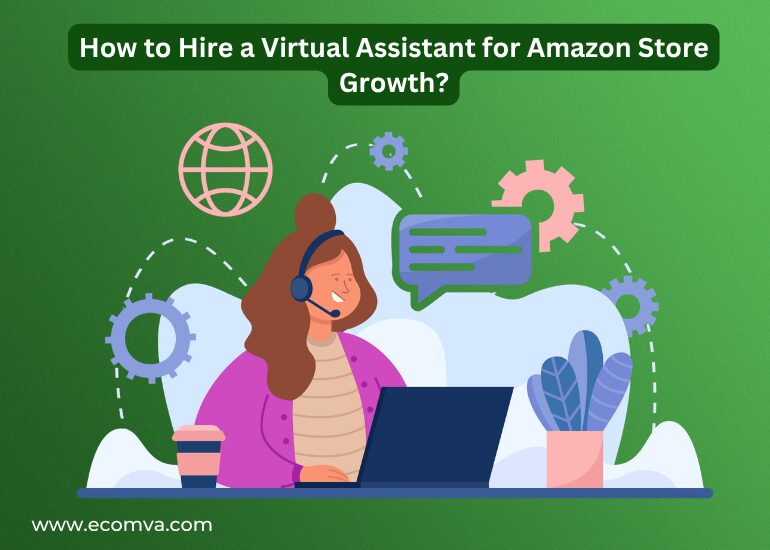
How to Hire a Virtual Assistant for Amazon Store Growth?
Running an Amazon store was simpler a few years ago. Now, between managing listings, keeping up with inventory, answering customer messages, running ads, and watching competitors undercut your prices overnight, it can feel like a second full-time job stacked on top of your actual job. Most sellers hit a roadblock not because their products are bad, but because they’re doing everything themselves.
That’s where the decision to hire a virtual assistant changes things. Not as a magic fix, but as a practical way to get out of the weeds so you can actually run your business.
What Is an Amazon Virtual Assistant?
An Amazon virtual assistant is someone who handles the day-to-day operational tasks that keep your store running. They’re not general admin help. The good ones know Seller Central and understand FBA workflows. These experts can jump in without a six-week onboarding process.
Amazon virtual assistants typically work remotely and are hired on an hourly or monthly basis. Think of them as an operational layer between you and everything that needs doing:
- listing updates,
- customer replies,
- inventory alerts,
- ad management.
The difference between a general VA and an Amazon-specific one matters. A general VA can schedule your emails. A virtual assistant for Amazon seller operations knows what a suppressed listing is and how to fix it before it costs you sales.
Signs You Actually Need To Hire a Virtual Assistant
A lot of sellers wait too long. Here’s what that usually looks like:
You’re spending your mornings on tasks, not decisions.
If the first two hours of your day are eaten up by listing updates or tracking orders. You’re copy-pasting responses to the same five customer questions: that’s a signal. These aren’t things that require your judgment. They require your time, and that’s the problem.
Inventory mistakes are becoming a pattern.
Stockouts and overstock errors don’t just hurt margins. They affect your ranking and reputation. When you’re managing everything manually, things slip. A dedicated VA catches the signals earlier.
Growth has stalled.
This one’s easy to miss. When you’re heads-down in operations, there’s no bandwidth for finding new products, improving listings, or running actual growth experiments. Busyness disguises stagnation.
Customer service is suffering.
Late responses, unresolved returns, review complaints that went unaddressed — these compound. Amazon notices response time. So do buyers. If your metrics are slipping, operational overload is often why.
If two or three of these sound familiar, it’s time to hire a virtual assistant.
What You Can Actually Hand Off?
When you hire amazon virtual assistant, you can assign them the following tasks:
Product listing optimization.
Writing keyword-rich titles, bullets, and descriptions takes real time and attention. A good VA handles initial builds, updates existing listings based on performance data, and supports A+ content uploads.
Inventory and order management.
This includes stock monitoring and restocking alerts. They also help coordinate inbound shipments and handle returns. For FBA sellers specifically, Amazon FBA virtual assistant services often include tracking reimbursement cases. Experts can manage FBA-specific issues like lost or damaged inventory.
Customer support.
Responding to buyer questions, handling negative feedback, and monitoring reviews. A VA can manage all of it with scripts and guidelines you set up once.
PPC campaign management.
An experienced VA can run, adjust, and optimize your Sponsored Products campaigns. This requires more training to hand off well, but it’s very doable once expectations are clear.
Store maintenance.
Price updates, promotion setup, product data corrections — the small stuff that adds up. When you outsource Amazon store management tasks like these, you get hours back every week without losing any control over how things run.
The Real Benefits of Hiring Amazon Virtual Assistants?
You get your time back for strategy.
This is the main one. When the operational layer is covered, you can focus on sourcing, brand positioning, and actually growing.
It costs less than in-house staff.
A VA at $10–15/hour, working part-time, is a fraction of a full-time hire. You’re not paying benefits, office space, or downtime.
Accuracy improves.
When one person is responsible for a task consistently, errors go down. That’s not a knock on you. It’s just how focus works.
You can scale without panicking.
Q4 hits. Sales volume doubles. With a VA already trained on your processes, handling the surge is manageable instead of chaotic.
The decision to hire a virtual assistant isn’t about offloading responsibility. It’s about distributing execution, so you’re not the bottleneck in your own business.
How to Hire One (Step by Step)
Step 1: List the tasks you want to offload.
Be specific. “Customer service” is vague. “Responding to buyer messages within 24 hours using our template library, flagging anything outside the script for my review” is something you can actually hire for.
Step 2: Choose your hiring channel.
You can search freelance platforms like Upwork or Fiverr. Agencies cost more. But they handle vetting and backup coverage. Both work. It depends on how much time you want to spend managing the hiring process itself.
Step 3: Screen for Amazon experience specifically.
Ask candidates to walk you through how they’d handle a suppressed listing, a customer return dispute, or a low inventory alert. General VA experience doesn’t transfer automatically. When you hire an Amazon virtual assistant, relevant experience with Seller Central is non-negotiable.
Step 4: Run a paid test task.
Before committing to a contract, assign a small real task. Pay them for it. How they approach it tells you more than any interview.
Step 5: Define expectations clearly upfront.
Working hours, communication method, KPIs, escalation process: put it in writing. Ambiguity creates friction later.
How much Does It Cost To Hire an Amazon VA?
Rates vary significantly.
- For someone handling basic tasks like listing updates and customer replies, expect $5–12/hour.
- For experienced VAs managing PPC or FBA operations, $15–25/hour is more realistic.
- Monthly retainer arrangements (often 20–40 hours/month) can work out to $400–$1,000/month depending on scope.
Making It Work Long-Term
Hiring is the start, not the finish. A few things that make the working relationship actually function:
| Area | Best Practice |
|---|---|
| Project Management | Use a structured tool (e.g., Trello, Asana, or shared trackers) to manage tasks and visibility |
| Task Documentation | Create SOPs for recurring tasks and include short visual walkthroughs for clarity |
| Communication Frequency | Maintain a defined cadence (e.g., weekly check-ins with clear agendas) |
| Performance Tracking | Track KPIs regularly and align them with operational goals |
| Issue Resolution | Identify and address problems early with clear escalation paths |
| Relationship Approach | Manage the VA as a long-term operational partner with defined accountability |
Wrapping Up
The point of choosing to hire a virtual assistant isn’t to step back from your business. It’s time to step back from the tasks that are eating your time without requiring your judgment. Operations can be systematized and delegated. Strategy can’t, and that’s where your energy belongs.
If your store is growing and you’re running out of hours, you need the support of a VA. Start small, test the fit, and build from there.