Amazon A+ Content vs Sponsored Brands: Where Should You Invest Your Budget First?

Do you find yourself stuck choosing between spending more on Sponsored Brands and improving your product description? You’re not alone. It feels like a small decision, but it can impact your entire growth. Here’s the truth: it’s not about choosing one over the other. It’s about doing things in the right order. Get the sequence right, and your ad spend grows results. Get it wrong, and your budget just gets used up. Let’s break down to understand the debate between Amazon A+ Content vs Sponsored Brands.
The Difference: A+ Content vs Sponsored Brands
Before choosing one, let us first know what each of these actually does.
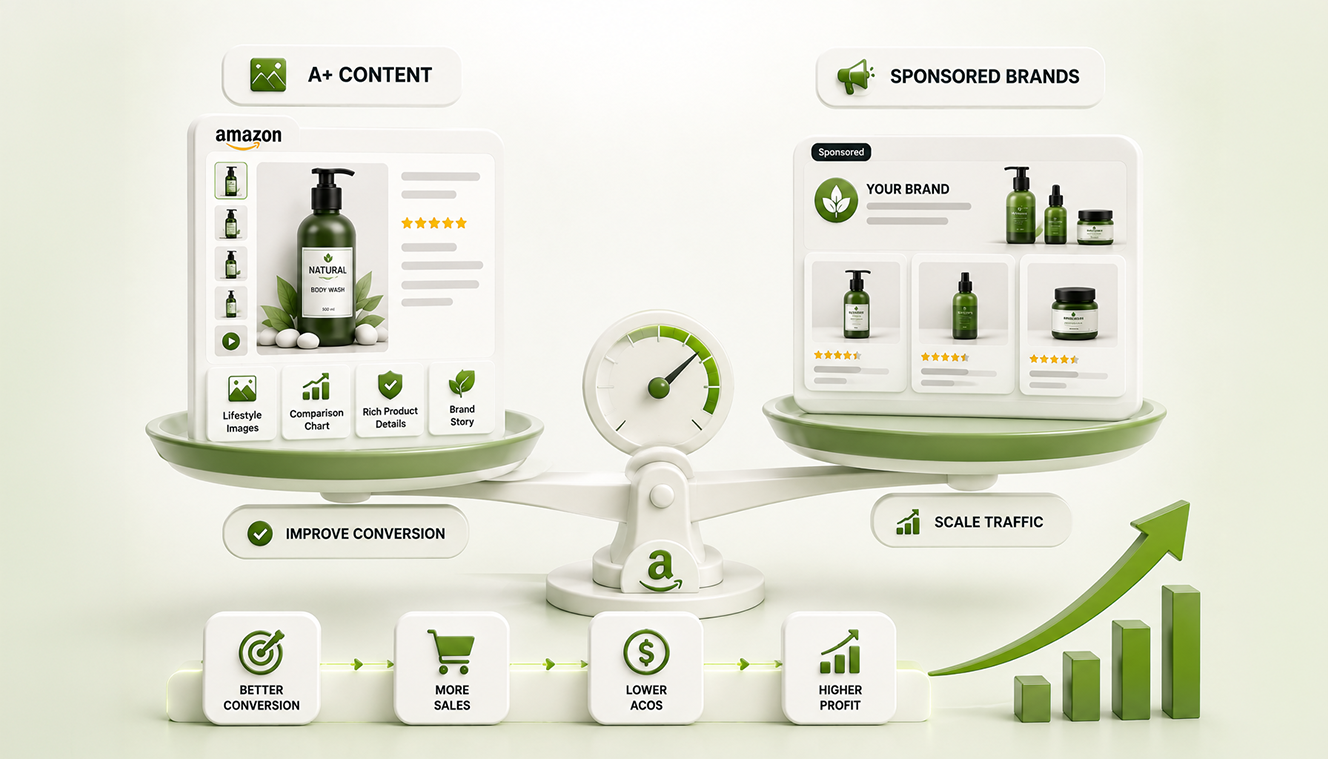
Amazon A+ Content replaces your plain-text product description with rich media like lifestyle images, comparison charts, or a brand story. It makes a listing feel like a real brand built it, not just a seller. You need Brand Registry to access it, and the basic version is free.
Sponsored Brands (formerly Headline Search Ads) are paid placements showing your logo, a headline, and a few products at the top of search results. You pay per click for that visibility.
So one is a conversion tool – build it once, and it keeps working. The other is a traffic tool you pay for every day it runs.
That’s the real Amazon A+ content vs sponsored brands difference: one fixes the page, the other fills it with visitors. Most experienced Amazon agencies say it the same way. Fix the page before you pay for the traffic. Paying for clicks that redirect to a landing page that doesn’t convert is like pouring water into a bucket that leaks.
Why Amazon A+ Content Usually Comes First
Imagine you’re getting 1,000 clicks a month from ads. At an 8% conversion rate, that’s 80 sales. If A+ Content improves your page and lifts conversion to 12%, you get 120 sales without spending more on ads. That’s the real A+ content conversion rate impact: same traffic, more results.
Amazon data suggests:
- Basic A+ Content can increase sales by 3–10%
- Strong A+ pages (with comparison charts, lifestyle images) can drive 15-20% growth, especially in visual categories like home, beauty, and apparel
There’s another benefit too. When your listing converts better, your cost per sale drops across all ads.
The bottom line is: Fix your listing first. Everything you do after that becomes more effective.
When Sponsored Brands Are Worth the Spend
It absolutely has its moment, and skipping it entirely would be a mistake, too. Sponsored Brands shines when:
- You already have a converting listing and just need more eyeballs on it
- You’re trying to defend your branded search terms from competitors bidding on your name
- You have multiple SKUs and want to showcase your catalog as a cohesive brand, not a single product
- You’re heading into a seasonal spike – Prime Day, Q4 holidays, and you need visibility fast
Think of Sponsored Brands as the megaphone. A+ Content is the message people hear once they walk into your store. A loud megaphone pointed at a confusing, half-empty store doesn’t really help anyone.
A+ Content vs Sponsored Brands: Side-by-Side Comparison
Sometimes a table just makes the comparison easier to digest than another paragraph would.
| Factor | A+ Content | Sponsored Brands |
|---|---|---|
| Cost | Free (basic tier) with Brand Registry | Pay-per-click with ongoing advertising spend |
| Primary job | Improves conversion by enhancing the product detail page experience | Drives qualified traffic to listings or a Brand Store |
| Setup time | Typically takes a few hours to a couple of days per ASIN, plus approval time | Can go live soon after campaign creation and approval |
| Long-term cost | Primarily a one-time content investment with periodic updates | Requires recurring monthly budget and ongoing optimization |
| Best for | Sellers receiving traffic but needing stronger conversion performance | Sellers with well-optimized listings looking to expand reach |
| Requires | Active Amazon Brand Registry enrollment | Amazon Brand Registry and an advertising budget |
Looking at this table, the pattern becomes pretty obvious. A+ Content is closer to a fixed investment, while Sponsored Brands behaves like a variable cost that scales with how much visibility you want.
Framed as Amazon-sponsored brands vs A+ content, the honest answer is that they sit at different stages of the same funnel. One earns trust on the page itself. The other gets strangers to that page in the first place. You genuinely need both eventually. The question this whole article keeps circling back to is just which one earns its place in your budget first, while resources are still limited.
Amazon Listing Optimization vs Advertising: A Budget Framework
Let’s get practical. If you’re trying to decide where to spend first, here’s a rough framework based on where your brand currently stands.
Brand-new listing, under 15 reviews: Don’t work on Sponsored Brands for now. Put your budget into Sponsored Products for keyword discovery while you create A+ Content. New listings convert 40-60% lower than established ones.
Listing has traffic, conversion is just okay: Fix A+ Content first. Healthy sessions with weak conversion mean the page needs work, not more clicks.
Listing converts well, you want more volume: Now, Sponsored Brands makes a lot of sense. You already know the page is working well. Working towards traffic is the natural next step.
Established brand with multiple SKUs: Focus on both, but prioritize the basics first. Make sure your listings and A+ Content are fully optimized and up to date before spending more on Sponsored Brands. A simple starting budget split:
- 70% on conversion (listings, A+ Content, Sponsored Products)
- 30% on visibility (Sponsored Brands)
You can adjust this based on your category and profit margins.
This isn’t a rigid rulebook, but the logic holds: fix the page, then fund the traffic.
Amazon A+ Content Benefits and Conversion Rate Impact
A strong A+ page is actually quite simple. It starts with a clear value proposition, shows real-life product images, includes a comparison chart for variations, and ends with your brand story. Each section helps answer questions, reduce doubts, and build trust before purchase. That’s where Amazon A+ content benefits really show up – better conversions, more confident buyers, and improved performance from the same traffic.
One thing worth flagging: A+ Content text isn’t directly indexed by Amazon’s search algorithm. So stuffing keywords into an A+ module won’t help you rank on Amazon search. But Google does crawl that content, so a well-written A+ page can pull in external search traffic too, and since conversion rate is itself a ranking signal, a higher-converting page indirectly helps your organic position anyway.
Amazon Brand Registry Benefits You Shouldn’t Overlook
Here’s something a lot of newer sellers miss. None of this – A+ Content, Sponsored Brands, even trademark protection on your listings is accessible without Brand Registry enrollment. It requires an active registered trademark, but once you’re in, the door opens to the Manage Your Experiments split-testing tool and stronger protection against listing hijackers, too.
So this entire budget conversation is downstream of one earlier decision: get registered. If you haven’t done that yet, that’s step zero, before either A+ Content or Sponsored Brands enters the picture.
Cost Comparison: Amazon A+ Content vs Sponsored Brands
Sponsored Brands isn’t cheap, and costs have crept up as more sellers compete for the same prime real estate. Depending on your category, cost-per-click can run anywhere from under a dollar in low-competition niches to $4 or more in crowded categories like beauty or supplements. That’s real money leaving your account every day the campaign runs.
A+ Content, by comparison, costs you time and design effort, not ongoing ad spend. Even if you hire help, and there are plenty of Amazon A+ content services that specialize in exactly this, it’s typically a one-time or occasional cost rather than a daily bleed. That difference alone is often reason enough to fix the page first.
Common Budget Mistakes With A+ Content and Sponsored Brands
A few patterns show up again and again when sellers get this wrong:
- Running Sponsored Brands on a listing with no A+ Content at all. You’re paying to send strangers to a half-finished page.
- Treating A+ Content as “set it and forget it.” Amazon lets you split-test through Manage Your Experiments; use it.
- Splitting a tiny budget evenly across both before either has data. Commit to one approach long enough to learn something, rather than spreading yourself thin and learning nothing.
- Ignoring mobile. Over 70% of Amazon traffic is mobile. A page that breaks on a phone screen is quietly costing you sales every day.
Where Should Your Amazon Ad Budget Go First?
There is one important takeaway from this whole comparison. Traffic without conversion is wasted money. But conversion without traffic just sits there quietly underperforming. None of the extremes works in the long run.
For most sellers, especially newer ones or anyone with a limited budget, the smarter starting move is Amazon listing optimization vs advertising spend; fix what happens after the click before paying more to generate the click. Build out solid A+ Content, get your bullets and images in shape, and let your existing traffic convert better. Once that page is genuinely pulling its weight, layer in Sponsored Brands to scale visibility.
Final Thoughts
Sequencing matters more than splitting evenly. Get the page right, watch the conversion numbers move, and then let advertising do what it does best – bring more eyes to something that’s already proven it can sell.
To know which among Amazon A+ content vs sponsored brands actually needs attention first, a quick audit of your Amazon store by an expert would definitely help.
Frequently Asked Questions
1. Do I need Brand Registry for both A+ Content and Sponsored Brands?
Yes. Both Amazon A+ Content and Sponsored Brands require an active Brand Registry account, which in turn requires a registered trademark for your brand.
2. Is A+ Content really free?
Yes. Basic A+ Content is available at no additional cost to Brand Registry sellers. Premium A+ Content becomes available after meeting Amazon’s eligibility requirements and does not require additional advertising spend.
3. When can I see results from A+ Content?
Many sellers begin noticing improvements within a few weeks, although evaluating performance after 30 to 60 days provides a more reliable measure of its impact.
4. Can I run Sponsored Brands without A+ Content?
Yes. However, directing paid traffic to a product page without optimized A+ Content may reduce conversion potential, making it harder to maximize advertising performance.
5. What’s a reasonable first-month budget for Sponsored Brands?
Many sellers begin with a daily budget of approximately $30 to $50 and adjust spending based on campaign performance and return on ad spend.
6. Should I hire an agency or do this myself?
The right choice depends on your available time and expertise. Many sellers manage campaign bidding themselves while outsourcing A+ Content creation to specialists with experience in Amazon copywriting and design.