Amazon FBA Expert vs Amazon Content Services: What Your Brand Needs Most
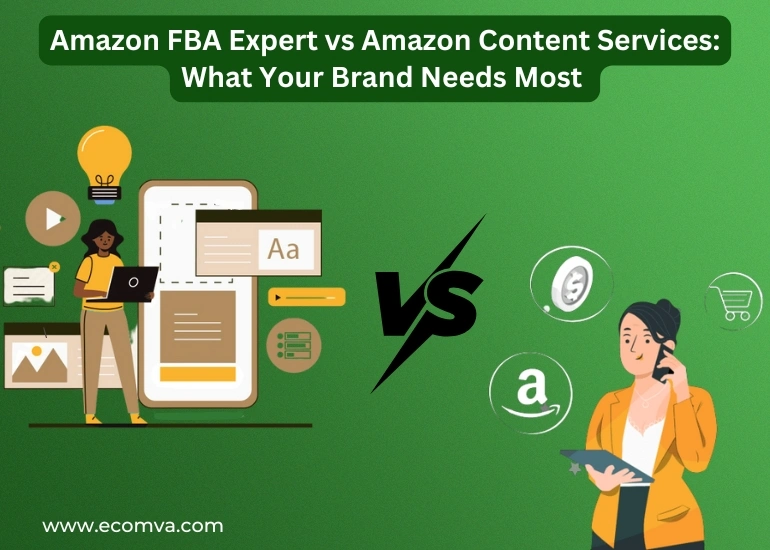
Amazon’s growth in 2026 is no longer driven by simply adding more products or increasing ad spend. Most brands that reach a plateau already have traffic, demand, and catalog breadth. The platform’s scale makes this clear: Amazon accounts for about 37.6% of the U.S. ecommerce market share, giving sellers access to a massive customer base that heavily influences online retail sales. What slows growth now is the strain placed on two very different areas of execution: backend operations and front-end content performance.
On one side, fulfillment workflows have become more complex. Inventory must be forecasted across multiple FBA warehouses, shipment delays need constant monitoring, and account health metrics must react quickly to small errors. This is where an Amazon FBA Expert becomes essential as a daily execution owner.
On the other hand, buyer behavior has changed. Shoppers now scan product pages more carefully, compare brands visually, and rely on structured content to make decisions faster. This shift has elevated the importance of Amazon content services, especially structured listing layouts and A+ modules that reduce friction before checkout.
The challenge for most brands is not choosing between operations and content. The real challenge is understanding which one becomes critical first, and how both eventually need to work together to support sustainable growth.
What an Amazon FBA Expert Actually Manages Day to Day
An Amazon FBA expert is responsible for keeping the operational engine running without disruption. This role goes far beyond shipping products to Amazon warehouses. It focuses on preventing issues that directly affect availability, account standing, and delivery performance.
Daily responsibilities typically include:
- Inventory forecasting and replenishment planning
Sales velocity is reviewed at the SKU level using historical data, recent trends, and promotional activity. Reorder points are calculated to account for inbound shipment lead times and Amazon receiving delays.
- FBA shipment creation and reconciliation
Shipments are built according to Amazon’s placement logic, carton-level requirements, and labeling rules. Once inventory is checked in, discrepancies between sent units and received units are logged and followed up through reconciliation cases.
- Account health monitoring
Key metrics such as order defect rate, late shipment rate, cancellation rate, and stranded inventory status are reviewed regularly. Even minor warnings are addressed early to avoid cascading penalties.
- Returns and exception handling
Returns are analyzed by reason codes. Repeated patterns, such as “not as described,” are flagged because they often signal listing or content issues that need correction.
An Amazon FBA specialist works within these systems daily. Their value comes from maintaining stability under volume, not from one-time optimizations. When this role is missing, brands often experience sudden stockouts, suppressed listings, or account warnings that slow growth without obvious warning signs.
What Amazon Content Services Focus On (And Why They Matter)
While operations keep a store functional, Amazon Content Services determine how effectively a product converts traffic into sales. Content is not cosmetic on Amazon; it directly influences buyer confidence, return rates, and time-to-decision.
Amazon content execution typically focuses on:
- Structured listing layouts
Product titles, bullet points, and descriptions are written to balance keyword relevance with scannability. The goal is to answer buyer questions quickly without overwhelming them.
- Amazon listing content services alignment
Attributes such as size, material, compatibility, and usage instructions are aligned across backend fields and front-end copy. Mismatches here often lead to confusion and higher return rates.
- A+ module placement strategy
Images, comparison charts, and text blocks are arranged to mirror how buyers scroll. Key objections are addressed before users reach reviews.
- Brand consistency across SKUs
Content layouts, tone, and visual structure remain consistent across product families. This builds recognition and improves cross-product trust.
Unlike ad copy, content remains live continuously. Poor structure or unclear messaging compounds over time. That is why brands increasingly invest in Amazon A+ content services as part of their core growth strategy rather than treating them as optional enhancements.
At higher competition levels, premium A+ content Amazon layouts become especially important. They allow deeper storytelling, richer visuals, and comparison logic that standard listings cannot support, which is critical in categories where products are technically similar.
Standard A+ Content vs Premium A+ Content: Practical Differences That Affect Conversion
Not all enhanced content performs the same way on Amazon. The difference between standard and premium formats is not visual polish alone; it is how much decision friction each format can remove.
Standard A+ content is built using fixed modules provided by Amazon. These include image-and-text blocks, simple comparison charts, and basic brand messaging sections. This format works well when:
- products are straightforward
- buyers already understand the category
- competition is limited to price or availability
Standard modules primarily reduce uncertainty by clarifying features and usage. They are effective for early-stage brands or SKUs with clear demand.
Premium A+ content Amazon, however, supports a different buyer mindset. It introduces advanced modules such as:
- full-width interactive image carousels
- multiple embedded videos
- modular storytelling sections
- advanced comparison tables across product lines
These layouts are designed to slow the scroll, not accelerate it. In competitive categories like electronics, beauty, or home goods, buyers compare brands visually before reading reviews. Premium layouts allow brands to control that comparison environment.
This is why Amazon A+ content services often evolve as brands scale. Standard layouts handle clarity. Premium layouts handle persuasion when buyers are deciding between similar options.
When Amazon Services Become Necessary
Many brands delay external support because early growth feels manageable. Problems often surface only after volume increases.
Amazon services typically become necessary when brands notice patterns such as:
- recurring stockouts despite healthy demand
- sudden drops in conversion without traffic loss
- increasing returns tied to “expectation mismatch”
- account health warnings appearing without obvious causes
At this stage, internal teams often spend time reacting instead of executing consistently. This is when brands begin combining operational oversight with structured content execution.
An Amazon FBA expert stabilizes backend execution by restoring inventory discipline, shipment accuracy, and account health tracking. At the same time, Amazon content services address front-end issues that reduce buyer confidence or increase post-purchase dissatisfaction.
The key is timing. Waiting too long creates compounding damage, while engaging support early allows controlled growth instead of recovery-driven fixes.
When an Amazon FBA Expert Becomes Non-Negotiable
There is a clear threshold where operational complexity outpaces manual oversight. This usually happens when:
- SKU count increases beyond a few dozen
- sales velocity varies significantly across products
- FBA inventory is split across multiple fulfillment centers
- promotions or seasonal spikes affect reorder timing
At this point, an Amazon FBA expert is no longer in a support role. They become the execution owner for fulfillment stability.
Their focus includes:
- aligning reorder quantities with sell-through rates
- adjusting shipment plans based on inbound congestion
- resolving stranded inventory before listings suppress
- monitoring fulfillment fees and storage penalties
An Amazon FBA specialist understands how small delays cascade. A missed replenishment window can suppress a listing. Suppressed listings reduce velocity. Reduced velocity increases storage risk. This chain reaction is why experienced execution matters more than high-level planning at scale.
How Amazon Listing Content and FBA Execution Work Together
Operations and content are often treated as separate concerns, but on Amazon they are tightly connected.
For example:
- high return rates trigger operational reviews
- “not as described” returns often originate from unclear content
- suppressed listings reduce inventory turnover
- poor turnover increases storage and aging inventory fees
This is where Amazon listing content services and fulfillment oversight intersect. Content clarifies expectations. Operations ensure availability. When both are aligned, listings remain active, inventory moves predictably, and account health stays stable.
Brands that treat these areas independently often fix symptoms instead of causes.
Choosing the Right Mix for Your Brand’s Growth Stage
There is no universal answer to whether content or operations should come first. The correct mix depends on where friction currently exists.
- Brands with strong demand but frequent stock issues benefit first from an Amazon FBA expert
- Brands with stable fulfillment but weak conversion benefit first from Amazon content services
- Brands in competitive categories usually need both in parallel
This is why EcomVA positions these services as complementary rather than competing. Execution stability and buyer confidence must scale together.
How EcomVA Supports Both Execution Layers
EcomVA supports Amazon brands across both dimensions without fragmenting responsibility. On the operational side, teams act as Amazon FBA specialists, managing inventory workflows, shipment accuracy, and account health monitoring.
On the content side, structured Amazon A+ content services focus on clarity, compliance, and conversion logic rather than visual decoration alone. From standard layouts to premium A+ content Amazon, execution follows platform guidelines and buyer behavior patterns.
This dual approach allows brands to grow without constantly shifting between vendors or re-aligning workflows.
Grow Your Amazon Brand Today!
Sustainable growth on Amazon comes from making deliberate choices about how work is structured and who owns it. When operational execution and content development are handled with clarity, teams spend less time fixing issues and more time building momentum.
Brands that scale steadily focus on alignment rather than volume. They assign responsibility at the right level, reduce overlap between roles, and ensure that each part of the Amazon ecosystem is managed with intent. This creates stability that protects performance as competition increases.
Over time, this disciplined approach turns Amazon from a demanding channel into a predictable growth engine. It supports long-term brand value instead of short-term gains.
FAQs
1. Can a brand work with content services without changing its existing FBA setup?
Yes. Amazon content services can be implemented independently of fulfillment workflows. Listing content, A+ modules, and brand assets can be updated without altering inventory, shipping, or FBA configurations.
2. Do content updates require approval every time on Amazon?
Yes. Most content updates, especially A+ modules, go through Amazon’s moderation process. Approval timelines vary, which is why planning updates alongside promotions or launches is important.
3. Is it risky to rely on one team for both operations and content?
No. When workflows, ownership, and reporting are clearly defined, combining operational and content execution under one provider often reduces misalignment rather than increasing risk.