Ecommerce Category Page SEO: The Missing Piece Behind Better Rankings and Conversions

If you run an ecommerce business today, you already know one thing. Getting products online is easy. Getting the right shoppers to discover those products consistently is where the challenge begins. Search engines continue to evolve, customer buying journeys are becoming more complex, and competition across ecommerce categories is growing every year. As a result, many online stores are realizing that their biggest SEO opportunity isn’t always product pages or blog content. It’s their category pages. This is where ecommerce category page SEO becomes increasingly important.
Category pages sit at the intersection of discovery and purchase intent. They help customers browse products while helping search engines understand your store structure. Yet many ecommerce businesses overlook them entirely.
Let’s explore why category pages matter, how they influence rankings, and the best ways to optimize them for long-term growth.
Why Ecommerce Category Pages Matter More Than Ever
Most ecommerce stores focus heavily on product pages. While product pages are important, category pages often target broader, higher-volume search terms.
For example:
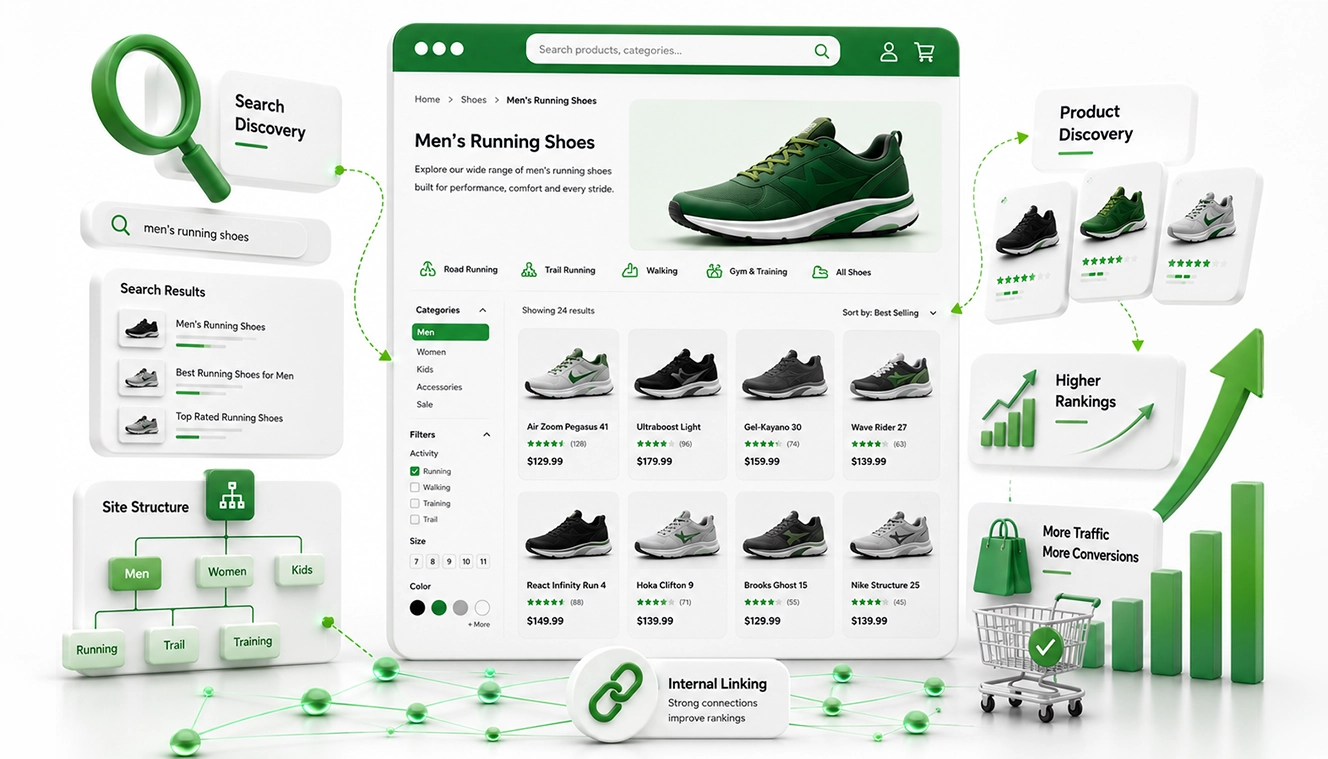
- Product Page: “Nike Air Zoom Pegasus 41”
- Category Page: “Men’s Running Shoes”
The category page typically attracts users earlier in the buying journey and often has significantly higher search volume.
Strong ecommerce category page SEO helps stores:
- Capture broader search demand
- Improve site architecture
- Guide users toward products
- Build topical relevance
- Support internal linking strategies
When optimized correctly, category pages can become some of the highest-traffic pages on an ecommerce website.
The Foundation: Understanding Search Intent
Before making any changes, it’s important to understand what shoppers expect when they land on a category page.
Many store owners ask how to optimize category pages for SEO, but the answer starts with intent.
Someone searching:
- “Women’s hiking boots”
- “Gaming laptops”
- “Organic skincare products”
is usually comparing options rather than looking for a specific product.
That means category pages should provide:
- Relevant product selections
- Clear filtering options
- Helpful category descriptions
- Easy navigation
Google increasingly rewards pages that satisfy search intent rather than simply matching keywords.
Category Page SEO Best Practices That Still Work in 2026
While SEO continues to evolve, several category page SEO best practices remain highly effective.
Create Unique Category Descriptions
One of the most common mistakes is using little or no content on category pages.
A short introduction helps search engines understand:
- Product types
- Customer needs
- Relevant keywords
- Category relevance
The goal isn’t to write hundreds of words of filler content. Instead, provide meaningful information that supports the shopper’s journey.
Optimize Page Titles Strategically
Strong category page title tag optimization remains one of the simplest ways to improve visibility.
A good category title should:
- Include the primary keyword
- Clearly describe the page
- Encourage clicks from search results
Example:
Men’s Running Shoes | Lightweight & Trail Running Footwear
Avoid keyword stuffing. Focus on clarity and relevance.
Improve URL Structure
Clean URLs support both users and search engines.
Instead of:example.com/category?id=12345
Use: example.com/mens-running-shoes
Simple URL structures improve crawlability and user experience.
Ecommerce Collection Page SEO: Why Shopify Stores Need Special Attention
Many Shopify stores use collections instead of traditional category pages.
This makes ecommerce collection page SEO particularly important.
Collection pages often rank for broad commercial keywords and serve as major entry points from search engines.
To improve the collection page performance:
- Add unique collection descriptions
- Optimize collection titles
- Improve internal linking
- Use descriptive image alt text
- Avoid duplicate collection structures
Small optimizations across multiple collections can create substantial traffic gains over time.
SEO for Product Category Pages: Beyond Keywords
Effective SEO for product category pages goes beyond simply adding keywords to page content.
Search engines evaluate:
- User engagement
- Page organization
- Product relevance
- Navigation quality
- Site structure
Category pages should help users quickly find products without creating friction.
Features such as filters, sorting options, and logical product organization contribute to both user experience and SEO performance.
The Power of Internal Linking
One of the most overlooked ranking factors is internal linking from category pages.
Category pages naturally act as hubs within an ecommerce website.
A well-structured category page can link to:
- Subcategories
- Featured products
- Buying guides
- Related collections
- Seasonal pages
This helps search engines understand content relationships while distributing authority throughout the site.
Strong internal linking also improves user navigation and encourages deeper engagement.
Common Category Page Mistakes That Hurt Rankings
Many ecommerce stores unintentionally weaken their category pages through avoidable mistakes.
Some of the most common issues include:
Thin Content
Pages with little or no descriptive content often struggle to rank competitively.
Duplicate Metadata
Using identical titles and meta descriptions across multiple categories confuses search engines.
Poor Internal Linking
Without strategic internal linking from category pages, valuable pages may remain underutilized.
Weak Category Structure
Overlapping categories create keyword cannibalization and indexing challenges.
Slow Loading Times
Category pages often contain large numbers of products and images. Poor optimization can affect performance and rankings.
Measuring Category Page SEO Performance
Tracking the right metrics helps determine whether optimizations are working.
Important indicators include:
- Organic traffic to category pages
- Keyword rankings
- Click-through rates
- Category page conversion rates
- Revenue generated from category page visitors
The goal is not simply to increase traffic but to attract qualified visitors who are more likely to purchase.
Bringing It All Together
Many ecommerce businesses invest heavily in product optimization while overlooking category pages.
Yet category pages often represent some of the strongest opportunities for growth.
Strong ecommerce category page SEO helps search engines understand your store while helping customers discover products more efficiently.
By applying proven category page SEO best practices, improving category page title tag optimization, strengthening internal linking from category pages, and focusing on effective SEO for product category pages, ecommerce brands can build a stronger foundation for both rankings and conversions.
In the end, category pages are more than navigation tools.
They’re some of the most valuable SEO assets an ecommerce store can have.
Struggling to rank your category and collection pages? Build a stronger ecommerce SEO foundation that drives qualified traffic and long-term growth.
FAQs
1. What is ecommerce category page SEO?
Ecommerce category page SEO involves optimizing category and collection pages to improve search visibility and attract shoppers looking for specific product groups.
2. How do you optimize category pages for SEO?
Effective optimization includes creating unique content, improving title tags and metadata, using clean URLs, strengthening internal links, and aligning page content with search intent.
3. What are category page SEO best practices?
Best practices include writing unique category descriptions, optimizing page structure, improving metadata, building relevant internal links, and enhancing the overall user experience.
4. Why is ecommerce collection page SEO important?
Collection pages often target high-intent commercial keywords and can generate substantial organic traffic when properly optimized for search engines and users.
5. How does internal linking from category pages help SEO?
Internal linking helps distribute authority across the site, improves search engine crawlability, and makes it easier for shoppers to discover related products and content.