Ecommerce Conversion Rate Benchmarks: What’s Good, What’s Bad, and Fixes

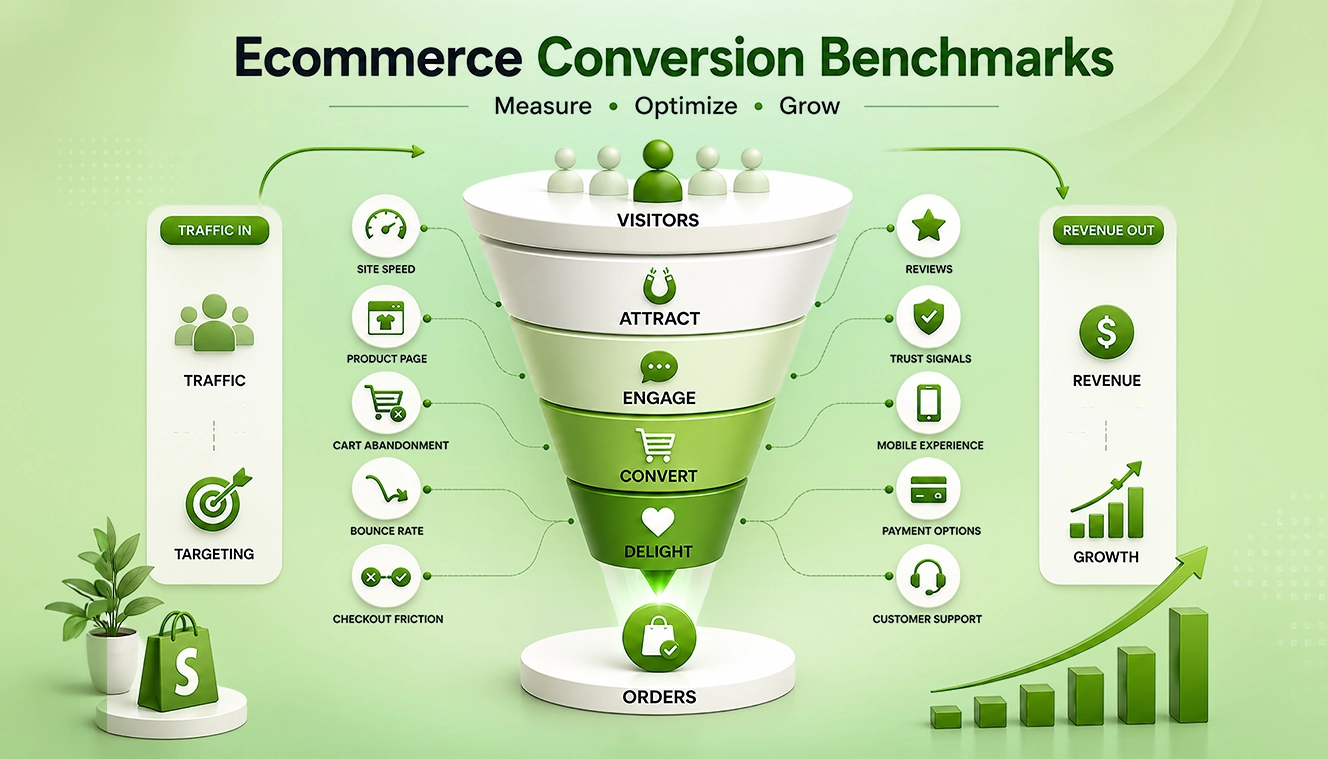
Honestly, getting traffic to your store isn’t the hard part anymore. You can run ads, push content, and bring people in.
But converting them? That’s where things start to trip.
And this is exactly why understanding your ecommerce conversion rate matters so much.
Because without context, numbers don’t really tell you anything. A 2% conversion rate – good or bad? It depends. And yeah, that’s where benchmarks come in.
In this blog, we’ll break it down in a simple way. Just what’s working, what’s not, and what you can actually fix.
What is Ecommerce Conversion Rate?
Your ecommerce conversion rate is basically the percentage of visitors who actually buy from your store.
Simple formula: Conversion Rate = (Orders / Visitors) × 100
So if 100 people visit your site and 2 buy, your conversion rate is 2%.
Sounds small. But in ecommerce, even a 0.5% increase can mean serious revenue growth.
What’s a “Good” Ecommerce Conversion Rate?
Here’s the thing. There’s no one perfect number. But there are ranges that give you a solid idea of where you stand.
| Performance Level | Conversion Rate |
|---|---|
| Poor | Below 1% |
| Average | 1% – 2% |
| Good | 2% – 3% |
| High Performing | 3% – 5%+ |
Now, if you’re running paid ads (especially in competitive markets like the US), you should ideally aim for 2.5% or higher. Anything below that? You’re likely leaving money on the table.
And yeah, different industries vary. Fashion might convert differently from electronics. Still, this gives you a realistic benchmark to work with.
Conversion Rate Alone Isn’t Enough
A lot of store owners obsess over just one number – the ecommerce conversion rate. But that’s incomplete. Because a store can have a decent conversion rate and still struggle with profitability.
Here are the supporting metrics you need to look at alongside it:
1. Average Order Value (AOV)
This tells you how much a customer spends per order. Higher AOV = more revenue without increasing traffic.
If your conversion rate is okay but revenue is low, this might be the issue.
2. Cart Abandonment Rate
This is where things get painful. Customers add products to their cart and then leave.
Typical benchmarks:
- 60% – 70% = common
- Above 75% = problem
A high cart abandonment rate usually points to friction – pricing surprises, complicated checkout, or trust issues.
3. Ecommerce Bounce Rate
This shows how many visitors leave without interacting.
- 20% – 40% = good
- 40% – 60% = average
- 60%+ = concerning
If your ecommerce bounce rate is high, your first impression isn’t working. Maybe slow loading, maybe confusing design, maybe wrong targeting.
4. Repeat Purchase Rate
This tells you how many customers come back. If you’re only relying on new customers, growth becomes expensive.
A strong repeat purchase rate means:
- Better customer experience
- Higher lifetime value
- More predictable revenue
5. Inventory Turnover Rate
This one gets ignored, but it matters. The inventory turnover rate shows how quickly you sell your stock.
Low turnover? You’re overstocked or not selling effectively.
High turnover? Good demand, but watch out for stockouts.
Signs Your Store Is Underperforming
Sometimes everything looks okay on the surface. You’re getting clicks. Ads are running. Traffic is decent. But revenue just… doesn’t match.
Here are a few red flags:
- High traffic, low sales (classic issue)
- Good product, but low conversion rate
- High cart abandonment rate
- Mobile users are not converting
- Sudden drop in performance after scaling ads
If you’re nodding at any of these, yeah, your store needs fixing.
Why Stores Struggle With Conversions (The Real Reasons)
Let’s not overcomplicate it. Most ecommerce stores don’t have a traffic problem. They have a conversion problem. Here’s what usually goes wrong:
1. Slow Website Speed
Even a 1 – 2 second delay can drop conversions. People don’t wait anymore. They just leave.
2. Weak Product Pages
If your product page doesn’t answer questions instantly, users bounce.
Missing:
- Clear benefits
- Social proof
- Trust signals
- Good images
And honestly, most stores underestimate this.
3. Complicated Checkout
Too many steps = lost sales.
Forced account creation, unclear shipping, limited payment options – all of it adds friction.
4. Mismatch Between Ads and Landing Page
If your ad promises one thing and the page shows something else, users leave.
Simple as that.
5. Lack of Trust
No reviews. No guarantees. No recognizable payment icons.
Users hesitate. And hesitation kills conversions.
How to Fix an Underperforming Ecommerce Store
Alright, let’s get into the practical part.
If your ecommerce conversion rate is below the benchmark, here’s what you should start fixing (step by step, not all at once).
1. Optimize Your Product Pages First
This is your biggest conversion lever. Focus on:
- Clear headlines (what problem does this solve?)
- Benefit-driven descriptions (not just features)
- High-quality images and videos
- Real customer reviews
And yeah, keep it simple. Don’t overload.
2. Improve Checkout Experience
Try this:
- Enable guest checkout
- Reduce steps
- Show total cost upfront
- Add multiple payment options
Even small tweaks here can reduce the cart abandonment rate significantly.
3. Work on Site Speed (Seriously)
Compress images. Use better hosting. Remove unnecessary scripts.
If your site takes more than 3 seconds, you’re losing people. No debate.
4. Add Trust Signals Everywhere
This includes:
- Reviews and ratings
- Money-back guarantees
- Secure checkout badges
- Clear return policies
People don’t trust easily online. You have to earn it.
5. Optimize for Mobile (This Is Big)
More than half of your users are on mobile. If your mobile experience is clunky, conversions drop.
Check:
- Button sizes
- Load speed
- Navigation simplicity
6. Use Data, Not Guesswork
Tools like heatmaps and session recordings, they show where users drop off. Fixing conversion issues without data is just guessing.
And guessing gets expensive.
Quick Reality Check
You don’t need a 5% conversion rate overnight. Even moving from 1.5% to 2.2% can massively improve revenue. That’s the game.
Small improvements. Compounding results.
Final Thoughts
If there’s one takeaway from this, don’t chase traffic blindly. Fix your store first.
Because a higher ecommerce conversion rate means:
- Better ROI on ads
- Lower acquisition cost
- More profit without scaling spend
And honestly, that’s where real growth happens.
If your store isn’t performing the way it should, start with the basics: Look at your numbers. Identify the gaps. Fix one area at a time.
Or, if you’d rather not figure it all out alone, working with an ecommerce operations agency can fast-track the process. They’ve already seen what works (and what doesn’t), so you don’t have to learn everything the hard way.
Frequently Asked Questions
1. What is a good ecommerce conversion rate in 2026?
A good ecommerce conversion rate varies by industry and product category, but most stores perform well between 2% and 3%. High-performing ecommerce businesses often achieve conversion rates above 3%.
2. Why is my ecommerce conversion rate low?
Low conversion rates are commonly caused by slow website performance, poorly optimized product pages, limited trust signals, or a complicated checkout experience that creates friction for shoppers.
3. How can I increase my average order value?
Average order value can be improved through strategies such as product bundles, upselling, cross-selling, and offering free shipping once customers reach a minimum purchase threshold.
4. What is an acceptable cart abandonment rate?
A cart abandonment rate between 60% and 70% is common for many ecommerce stores. Rates above 75% may indicate checkout issues or other barriers that discourage customers from completing their purchases.
5. Does traffic quality affect conversion rate?
Yes. Visitors who closely match your target audience are more likely to convert, while poorly targeted traffic often results in higher bounce rates and lower conversion performance.
6. How long does it take to improve conversion rates?
The timeline depends on the improvements implemented. Technical fixes such as checkout optimization may produce results quickly, while broader UX and website enhancements typically require more time to deliver measurable gains.