Ecommerce Virtual Assistant vs In-House: What Actually Works Better for Scaling Brands in 2026?

There’s a point in every growing ecommerce business where things start falling a little. Orders increase. Customer queries pile up. Listings need constant updates. Ads need attention. And suddenly, what once felt manageable becomes chaotic. This is where the debate around ecommerce va vs in-house really begins to matter. It sounds like a simple decision. It isn’t.
Let’s break this down honestly, comparing costs, performance, flexibility, and what actually works in today’s fast-moving ecommerce ecosystem.
Ecommerce VA vs In-House: Why This Decision Matters in 2026
Ecommerce today isn’t just about selling products. It’s about speed, experience, and consistency.
With Google’s 2026 core updates focusing heavily on:
- Page experience (Core Web Vitals)
- Content quality and freshness
- Operational efficiency (yes, indirectly)
Your backend operations now directly affect your growth. Slow response times, delayed updates, poor inventory sync – these don’t just hurt operations, they hurt rankings and revenue.
So choosing between ecommerce virtual assistant vs. an in-house is no longer just a hiring decision. It’s a growth strategy.
Understanding the Two Models
Let’s keep it simple and understand what each model exactly means.
In-House Ecommerce Team
This is your traditional setup. You hire employees to handle:
- Order processing
- Customer support
- Product uploads
- Inventory management
- Marketing coordination
They work from your office (or remotely, but still full-time employees).
Ecommerce Virtual Assistant (VA)
A virtual assistant is a trained remote professional who handles specific ecommerce tasks.
Think:
- Amazon or Shopify management
- Customer support
- Listing optimization
- Data entry
- Ad monitoring
You don’t hire them as full-time employees. You outsource.
Cost Comparison: Virtual Assistant vs. Ecommerce Employee
Let’s talk numbers, because this is usually where decisions start.
| Cost Factor | In-House Team | Ecommerce VA |
|---|---|---|
| Salary | Higher fixed monthly employment cost | Flexible pricing through hourly, project-based, or monthly support packages |
| Infrastructure | Requires office space, software, equipment, and operational resources | Typically works remotely without additional infrastructure requirements |
| Training | Often requires ongoing onboarding and skill development | Usually arrives with ecommerce-specific experience and platform familiarity |
| Benefits | May include insurance, bonuses, paid leave, and other employment costs | Additional employee benefits are generally not required |
| Scalability Cost | Expanding capacity often requires additional hiring and overhead | Support can typically scale up or down based on operational needs |
An in-house hire in the US can cost 3-5x more than a skilled ecommerce VA.
That’s why many brands exploring virtual assistant vs ecommerce employee are leaning toward Virtual Assistants, especially in early and growth stages.
Performance: Who Actually Delivers Better?
Now here’s where things get interesting. Because performance isn’t just about skill. It’s about structure.
In-House Team Strengths
- Better brand alignment
- Immediate availability
- Easier collaboration
But…
- Limited bandwidth
- Productivity depends on supervision
- Scaling takes time
Ecommerce VA Strengths
- Specialized expertise (Amazon, Shopify, Etsy, etc.)
- Faster execution (they’ve done it before)
- Highly task-focused
But…
- Requires clear SOPs
- Communication gaps can happen
- Not always deeply invested in your brand
Outsource Ecommerce Operations vs Hiring: What Actually Works
In most cases:
- Routine tasks → VAs outperform
- Strategic roles → In-house wins
So instead of choosing one over the other, smart brands combine both.
Ecommerce Operations Outsourcing Benefits: Why Flexibility Wins
Let’s say your sales double during a festive season. What happens?
With In-House Team:
You scramble. Hire temporary staff. Train them. Hope they perform.
With Ecommerce VA:
You scale instantly. Add hours. Add more VAs. Reduce later. No long-term commitment. No overhead stress.
This is where the benefits of outsourcing ecommerce operations become very clear.
When to Hire Ecommerce VA vs In-house: Key Signs You Shouldn’t Ignore
Not every business needs a VA from day one. But here are clear signs:
- You’re spending too much time on repetitive tasks
- Your order volume is increasing consistently
- Customer support is becoming overwhelming
- You want to scale but don’t want fixed costs
If that sounds familiar, it’s probably time to answer the question of when to hire ecommerce VA.
When an In-House Team Makes More Sense
There are situations where hiring internally is the better move.
- You need full-time strategic roles
- Your processes are complex and sensitive
- You want tight brand control
- You’re operating at enterprise scale
In these cases, relying only on outsourcing may not work.
Hybrid Model: What Most Successful Brands Are Doing
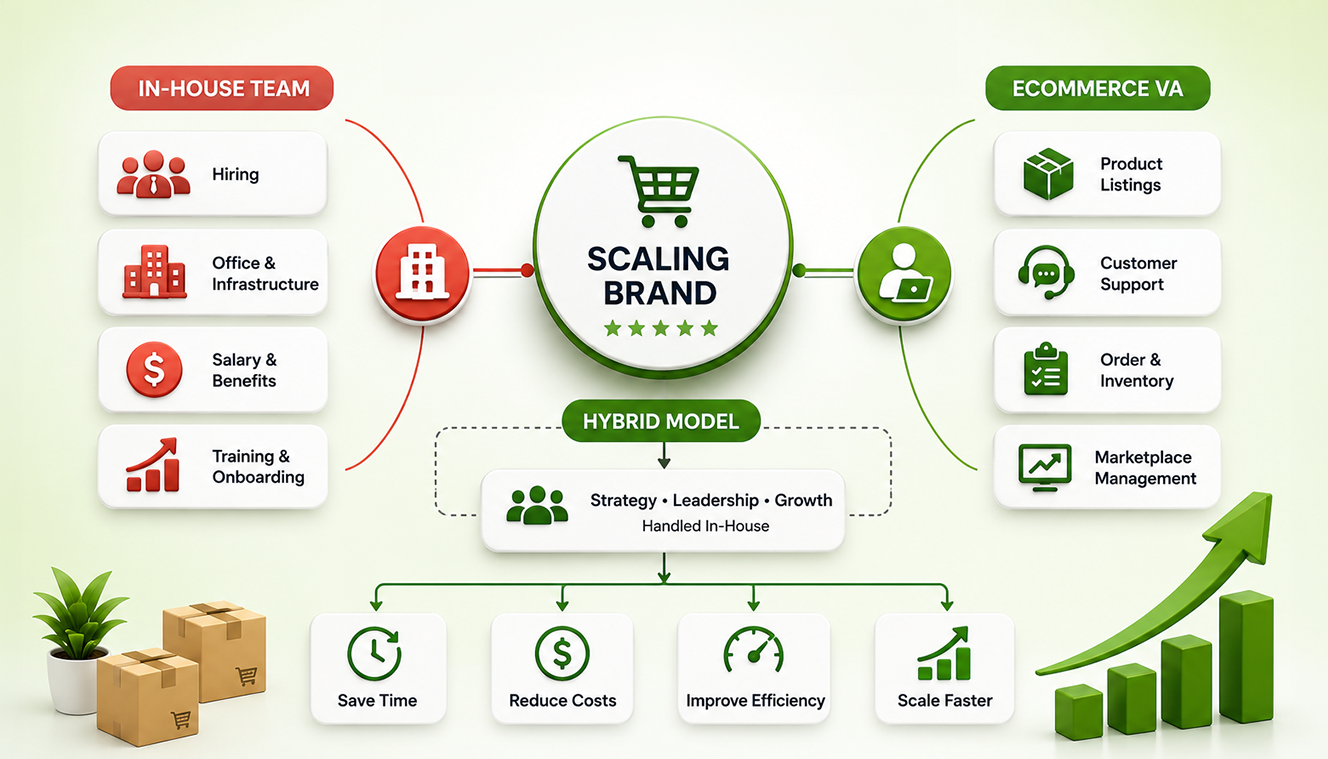
Here’s the truth most blogs skip. The best-performing ecommerce brands in 2026 aren’t really debating between outsource ecommerce operations vs hiring. Instead, they’re building hybrid teams that give them both control and flexibility.
In this kind of setup, the in-house team focuses on the bigger picture. The areas that need deeper involvement and long-term thinking. Things like:
- Strategy and business direction
- Marketing leadership and campaign planning
- Brand positioning and consistency
These are not just tasks; they shape how the business grows.
At the same time, ecommerce virtual assistants take over the execution-heavy work. The kind that needs consistency, speed, and attention to detail:
- Product uploads and listing updates
- Order processing and inventory handling
- Customer support and query resolution
- Marketplace management across platforms
This division just makes things smoother. Your core team isn’t stuck doing repetitive tasks. Your operations don’t slow down when things scale. And you’re not locked into high fixed costs for work that can be handled more efficiently.
The outcome is pretty clear:
- Better cost efficiency without compromising output
- Easier scalability during peak seasons or sudden growth
- More stable, streamlined day-to-day operations
It’s not really about choosing one over the other anymore. It’s about building a high-productivity ecommerce team where each one does exactly what they’re best at.
Ecommerce VA vs In-House Cost Comparison (Realistic View)
Let’s simplify this further by taking a look at the below ecommerce VA cost comparison table:
| Monthly Expense | In-House Employee | Ecommerce VA |
|---|---|---|
| Entry-Level | $3,000 – $5,000 | $500 – $1,500 |
| Mid-Level | $5,000 – $8,000 | $1,000 – $2,500 |
| Scaling Cost | Higher due to payroll, benefits, and operational overhead | More controlled through flexible support models |
This doesn’t mean VAs are “cheap”. It means they’re cost-efficient for the value they bring.
Common Mistakes Brands Make
Some brands assume that hiring an ecommerce VA will instantly fix their operational issues. But when things don’t work out, they blame the model. But actually, the problem lies in how it’s implemented.
It’s not that ecommerce virtual assistants don’t deliver. It’s that the expectations and structure around them are often unclear.
For example:
- There are no defined processes or SOPs, so tasks get handled inconsistently
- Execution-focused roles are expected to contribute to strategy, which creates confusion
- Communication is either too vague or too infrequent, leading to delays and errors
- Teams try to micromanage remotely, which slows down productivity instead of improving.
These small gaps start to build up over time. What could have been a smooth, scalable system turns into frustration for both sides.
The truth is, VAs work really well when they’re given clarity, structure, and the right scope of responsibility. Without that, even the most skilled professionals can struggle to deliver their best work.
Final Thoughts: The Choice
If you’re still wondering, here’s a simple way to decide:
- Want control and long-term internal growth? → Go in-house
- Want flexibility, speed, and lower costs? → Go with VAs
- Want the best of both worlds? → Build a hybrid model
Because agility wins in today’s ecommerce landscape. If you’re feeling tired of managing everything alone, you don’t have to.
Start small. Prepare a strategy to hire a VA. Delegate a few tasks. You’ll quickly see the difference. And once you do, there’s no going back.
Because growth isn’t just about selling more, it’s about operating smarter.
Frequently Asked Questions
1. Is an ecommerce virtual assistant reliable?
Yes. When hired through a reputable provider and supported by clear processes, ecommerce virtual assistants can deliver consistent and reliable operational support across a wide range of store activities.
2. What tasks can I outsource to an ecommerce VA?
Commonly outsourced tasks include product listing management, order processing, customer support, inventory updates, marketplace administration, and basic advertising support.
3. How do I manage a remote VA effectively?
Effective management typically involves documented procedures, task management tools, clear communication channels, and regular performance reviews to maintain quality and accountability.
4. Will outsourcing affect my brand quality?
Not when workflows and expectations are clearly defined. In many cases, outsourcing improves consistency, response times, and operational efficiency while maintaining brand standards.
5. What’s the biggest advantage of outsourcing ecommerce operations?
Flexibility is one of the biggest advantages. Businesses can scale support up or down as needed without the long-term commitments and overhead associated with expanding internal teams.