Email Marketing Automation: How It Works and Why Ecommerce Brands Need It


Most Shopify owners think they already have an email marketing strategy. Something they can manage with a newsletter or a couple of discount codes around holidays. Automation is not something they consider, since those kinds of marketing efforts are routine for them, and they follow them as time passes.
Automation is different. It’s a system that watches what a shopper does, then responds without anyone touching a keyboard. Someone adds a hoodie to their cart and leaves. Twenty minutes later, a reminder lands in their inbox. Someone places their first order. Three days after delivery, a review request shows up. None of that requires a marketer sitting at a desk clicking send.
How Email Marketing Automation Actually Works
So, to say, this is how it actually works. A trigger (for example, registration, cart abandonment, purchase) signals that the prepared flow of actions can now be executed one by one. Klaviyo, Omnisend, and ActiveCampaign are automation platforms that handle such logic. All you are required to do is set up your conditions once, and then the system will keep verifying them regularly.
The standard automated email flow consists of three or four emails sent over several days. The first one usually has a quick delivery time, and sometimes the customers will get it within a couple of hours. Subsequent emails create urgency, add social proof, or offer a small incentive. In reality, this sequence is way more important than most people think. If, for instance, you lead with a discount early on, customers will be conditioned to always look for one.
That’s the operational core of any modern email marketing strategy. Not the newsletter. The flows running quietly in the background.
Why Ecommerce Brands Can’t Skip This Anymore
The numbers make the case better than any pitch could. Shopify stores in 2026 are seeing an average email marketing ROI of $42 for every $1 spent, up slightly from $40 the year before, driven largely by better automation and sharper segmentation. Top performers push that even further, sometimes past $70 per dollar spent.
What’s more telling is where that revenue actually comes from. Welcome messages and abandoned cart emails alone drove roughly three out of every four automated orders in 2025. Two flows. Most of the results. That’s worth sitting with for a second, because plenty of stores still spend their time building ten different automations instead of perfecting two.
Klaviyo open rates tell a similar story. Welcome series emails commonly reach 50 to 60 percent open rates, the highest of any automated flow, while abandoned cart emails typically land between 40 and 45 percent. Compare that to a standard promotional blast, which usually sits closer to 15 to 20 percent, and the gap explains itself.
Speed matters too. Faster isn’t always better everywhere in marketing, but for cart recovery it clearly is. Stores that send that first recovery email within 60 minutes recover roughly three times more carts than those who wait a full day.
The Flows Worth Building First
Not every automation deserves equal attention. Some genuinely move revenue. Others just add noise to an inbox.
Welcome Series
This is the highest-converting flow available to a new store. Subscribers just opted in. They’re curious. Meet that curiosity with a short, warm introduction rather than an immediate sales pitch.
Cart abandonment sits right behind it.
- First email: a simple reminder, sent within 30 to 60 minutes
- Second email: light social proof or a review, sent around 24 hours later
- Third email: a small incentive, only if the first two didn’t convert
Post-purchase Flows
Post-purchase flows are skipped constantly, and that’s a mistake. A review request sent 7 days after delivery, timed to when the product has actually arrived and been used, tends to generate several times more reviews than one sent the moment an order ships. Reviews build trust. Trust drives the next sale.
Win-back Emails
Win-back sequences are the quiet workhorse nobody brags about. They target subscribers who’ve gone cold, sixty or ninety days without opening anything. A short “we miss you” message with a modest offer brings back a slice of that list every single time. Not dramatic. Just steady.
Automation Alone Isn’t a Strategy
Here’s where a lot of stores trip up. They install Klaviyo, flip on four templates, and assume the work is done. It isn’t. Automation is the engine. Strategy is the map telling that engine where to go.
A real email marketing strategy asks harder questions first. Who’s actually on this list? What do first-time buyers need to hear that repeat customers don’t? Should a subscriber in a low-intent segment get the same frequency as someone who just clicked three product pages? Get these wrong, and even a technically perfect flow underperforms.
Segmentation is where most of the missed opportunity lives. Two customers who look identical on paper- same city, same order size- can have completely different buying triggers. One responds to scarcity language. The other responds to a straightforward feature comparison. Blanket messaging misses both.
When to Bring in an Email Marketing VA
Building flows takes time, which most founders don’t have. Between operations, sourcing, and customer service, email often becomes the thing that gets pushed to Friday afternoon, then not at all.
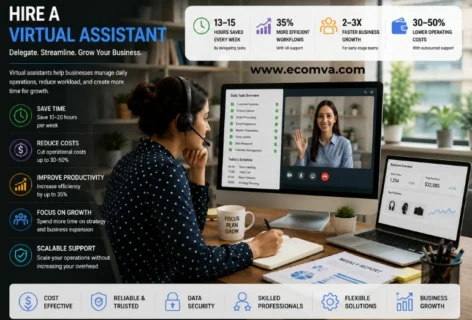
This is usually where an Email Marketing VA earns their keep. A skilled VA handles the parts that eat hours: writing flow copy, setting up segments, running A/B tests on subject lines, and pulling weekly performance reports. They’re not there to replace strategy. They’re there to execute it consistently, which, honestly, is the part most in-house teams struggle with anyway.
Cost varies depending on scope and where the VA is based. Some run hourly; others work on a flat monthly retainer. Either way, the math usually works out favorably once you account for the hours a founder would otherwise spend clicking through Klaviyo at midnight.
Getting Started Without Overbuilding
Try not to launch all the flows at the same time. It is better to focus on the welcome and cart abandonment flows first. Once these two are functioning really well, you can add post-purchase and win-back flows. Only after making sure the four basic flows are solid can you start adding browse abandonment.
An e-mail marketing tip that is very handy: instead of creating a catchy subject line, go for a more straightforward and specific one. Also, remember not to choose send times based on a certain reference and always test them on your target audience. If an automation is working well at one time, it doesn’t necessarily stay effective forever. Check your automations every three months!
Email marketing automation isn’t a magic pill or a shortcut at all. Rather, it is a powerful setup or system you set up. If well-constructed, it will become a silent background worker for you. While still produce revenue even long after your setup period has passed.
Feeling frustrated with ineffective email marketing tips and strategies that fail to generate real results? EcomVA is the ultimate solution for e-commerce brands looking to automate and optimize their email flows effectively. From your first-time shopper’s welcome series to your last-chance win-back campaign, we manage flows for you and help you keep increasing your revenue.
Frequently Asked Questions
1. What’s the difference between email marketing automation and a regular email campaign?
A regular email campaign is a one-time message sent to a selected audience based on a schedule. Email marketing automation runs continuously and is triggered by customer actions, such as abandoning a cart, making a purchase, or signing up for a store.
2. How many automated flows does a new ecommerce store actually need?
A new ecommerce store can start with two essential flows: a welcome series and an abandoned cart flow. Once these are optimized, adding post-purchase and win-back flows can help strengthen retention and generate additional automated revenue.
3. What Klaviyo open rates should I expect from my flows?
Performance varies by audience, industry, and flow type. Welcome emails can often achieve open rates around 50% to 60%, while abandoned cart flows may reach approximately 40% to 45%. Promotional campaigns typically have lower open rates, often around 15% to 20%.
4. Is hiring an Email Marketing VA worth it for a small store?
Yes, particularly when email marketing is consistently pushed aside because of daily operational tasks. An Email Marketing VA can support campaign execution, copywriting, segmentation, testing, and flow management while allowing business owners to focus on growth.
5. Should I lead with a discount in my abandoned cart emails?
Not necessarily. The first abandoned cart email should usually focus on a simple reminder and reinforce the value of the product. If the customer still does not convert, a later email can introduce an incentive when appropriate.