Website Design VA Tips to Improve Ecommerce Conversions

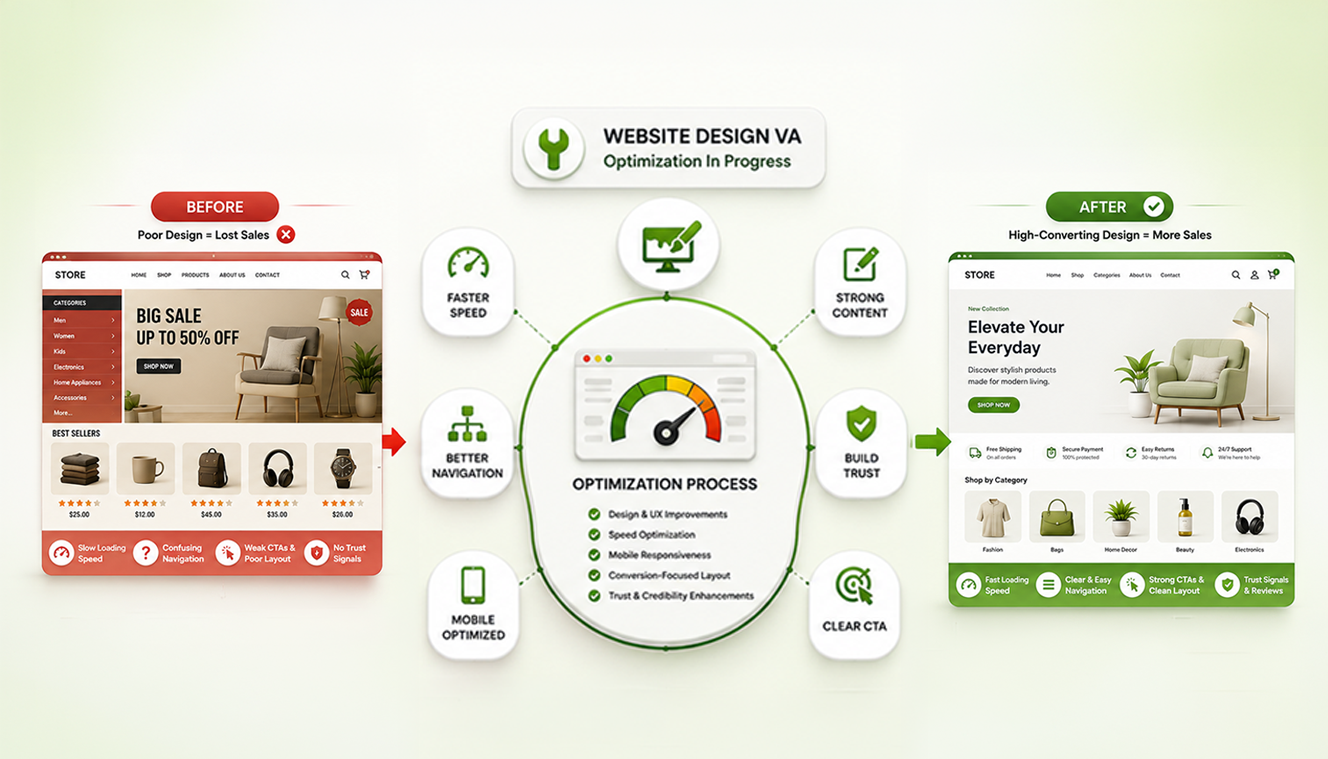
You’ve spent money on ads. Traffic is coming in. People are clicking, browsing, and then leaving. No sales. No signups. Just silence. At first, it feels like a marketing problem.
But more often than not, it’s something else. Your ecommerce website design is quietly working against you, and your conversion rate is not satisfactory.
And the tricky part? Most store owners don’t even realize it.
Because small design issues, tiny ones, can create massive drops in conversions. And fixing them doesn’t always require a full redesign. Sometimes, you just need the right execution support, like a skilled website design virtual assistant.
Let’s break it down.
Why Ecommerce Design Directly Impacts Your Revenue
Before we jump into the signs, here’s something important: Your website is not just a storefront. It’s your salesperson. Every button, every image, every second of loading time shapes user behavior.
In 2026, with shorter attention spans and AI-driven expectations, users don’t “figure things out” anymore. If your store feels confusing, slow, or overwhelming, they leave. Instantly.
That’s the real impact of website design on sales.
Quick Snapshot: Good vs Poor Ecommerce Design
| Element | High-Converting Design | Poor Website Design for Ecommerce |
|---|---|---|
| Navigation | Clear, intuitive, and easy to follow | Cluttered, confusing, or difficult to navigate |
| Speed | Loads within 2–3 seconds and feels responsive | Slow-loading pages and laggy user experience |
| Mobile UX | Seamless browsing and checkout experience across devices | Broken layouts, usability issues, or difficult interactions |
| CTA | Visible, compelling, and easy to act on | Hidden, unclear, or difficult to locate |
| Trust Signals | Strong presence of reviews, policies, and credibility indicators | Missing, weak, or difficult-to-find trust elements |
Now let’s go deeper.
1. Your Website Loads Slowly
A delay of even 1-2 seconds can significantly drop your conversion rate. And yeah, users notice. Heavy images, messy code, too many plugins. All of this creates friction.
This is one of the most common ecommerce UX problems, yet it’s often ignored.
How a Website Design VA Fixes It:
- Compresses images without losing quality
- Cleans unnecessary scripts
- Optimizes Core Web Vitals (LCP, CLS, INP)
- Coordinates with developers if needed
Result? Faster pages, smoother journeys, and better conversions.
2. Your Navigation Feels Confusing
Ever landed on a website and thought, “Where do I click?” That’s exactly how your users feel if your menu is cluttered.
Too many categories. Poor labelling. No hierarchy.
These small ecommerce store design mistakes create decision fatigue, and people exit.
Fix with a VA:
- Simplifies menu structure
- Improves product categorization
- Adds smart filters and search
Clean navigation = better flow = higher conversion rate
3. Your Product Pages Don’t Build Confidence
Your product page is where decisions happen. If it lacks clarity, users hesitate.
Common issues:
- Low-quality images
- Weak descriptions
- Missing reviews
- No clear value proposition
This is a classic case of ecommerce landing page design issues.
What a VA Can Do:
- Add high-quality visuals and zoom features
- Rewrite descriptions with benefits, not just specs
- Integrate reviews and trust badges
- Improve layout for readability
Suddenly, your product page starts selling.
4. Your Mobile Experience is Broken
More than 70% of ecommerce traffic is mobile now. And still, so many stores treat mobile as an afterthought.
Buttons too small. Text overlapping. Slow load times. It’s frustrating. And users don’t stick around.
How can a VA fix:
- Mobile responsiveness testing
- Fix layout and spacing issues
- Optimize touch interactions
- Improve mobile speed
A smooth mobile experience alone can dramatically improve your conversion rate, thanks to a well-designed ecommerce website.
5. Your Call-to-Action (CTA) Isn’t Clear
“Add to Cart” should not be hard to find. But on many websites, it blends in or appears too late.
Users shouldn’t have to search for the next step.
Common Problems:
- Weak CTA copy
- Poor placement
- Low contrast
VA Solution:
- Tests CTA placement
- Improves wording (“Buy Now”, “Get Yours Today”)
- Uses contrasting colors
Sometimes, a simple CTA tweak can boost conversions instantly.
6. Your Website Doesn’t Build Trust
People don’t buy if they don’t trust you. It’s that simple.
Missing trust elements is one of the biggest website design factors affecting sales.
Look for:
- No reviews
- No return policy
- No secure payment badges
- No real brand identity
VA Fix:
- Adds testimonials and ratings
- Displays guarantees and policies
- Improves branding consistency
- Highlights security elements
Trust removes hesitation, which kills conversions.
7. Your Design Feels Outdated or Overwhelming
Sometimes it’s not one issue, it’s everything combined. Too many colors, fonts. and happening. Or worse, a design that feels outdated.
Users subconsciously judge your credibility based on design. That’s why poor design leads directly to low conversions.
VA Can Help By:
- Cleaning up the layout
- Improving visual hierarchy
- Ensuring consistent branding
- Making the site feel modern and easy
Not fancy. Just clean and effective.
Where a Website Design VA Really Adds Value
Here’s the thing. Most business owners don’t have time to fix all this. And hiring a full design agency? Expensive. Slow.
A website design virtual assistant sits right in the middle.
What a VA Typically Handles:
- UX improvements
- Landing page tweaks
- Speed optimization
- Product page enhancements
- Ongoing A/B testing support
They don’t just “design”, they improve performance.
Modern Ecommerce Trends You Can’t Ignore
If your store isn’t adapting, it’s falling behind. Some key trends shaping conversions today:
- AI-powered personalization
- Voice and visual search optimization
- Faster and smoother checkout experiences
- Micro-interactions, like small animations that guide users
- Performance-first design
A skilled VA can help implement and maintain these without overwhelming your team.
Quick Self-Audit Checklist
If you’re unsure where you stand, check this:
- Does your site load under 3 seconds?
- Is navigation simple and clear?
- Are product pages persuasive?
- Is the mobile experience smooth?
- Are CTAs obvious and strong?
- Do you show trust signals?
- Does your design feel modern?
If you said “no” to even 2 or 3, your conversions are likely suffering.
Final Thoughts
Improving your ecommerce conversion rate isn’t about redesigning everything overnight. It’s about fixing friction. Small improvements, layered over time, create massive results.
And honestly, you don’t have to do it alone.
Need Help Fixing Your Store?
If your store is getting traffic but not converting, it’s time to look deeper. A skilled virtual assistant for website design can identify gaps, fix design issues, and continuously optimize your store for better performance.
No guesswork. Just better conversions. And yeah, if your gut is telling you something’s off with your website, it probably is.
The good news? It’s fixable.
Frequently Asked Questions
1. How does website design affect ecommerce conversion rate?
Website design influences how visitors navigate, engage with, and trust your store. Poor design can create friction, increase bounce rates, and reduce conversion opportunities.
2. What are the most common ecommerce UX problems?
Common ecommerce UX issues include slow page loading times, confusing navigation, weak calls-to-action, poor mobile experiences, and a lack of visible trust signals.
3. Can small design changes really improve sales?
Yes. Improvements such as faster page speed, clearer calls-to-action, and better navigation can enhance the user experience and contribute to higher conversion rates.
4. What does a website design virtual assistant do?
A website design virtual assistant helps maintain and optimize store design, improve user experience, resolve usability issues, and support ongoing website performance improvements.
5. How often should I update my ecommerce design?
Ecommerce design should be reviewed and optimized regularly based on customer behavior, performance data, and evolving user expectations rather than relying solely on occasional redesigns.