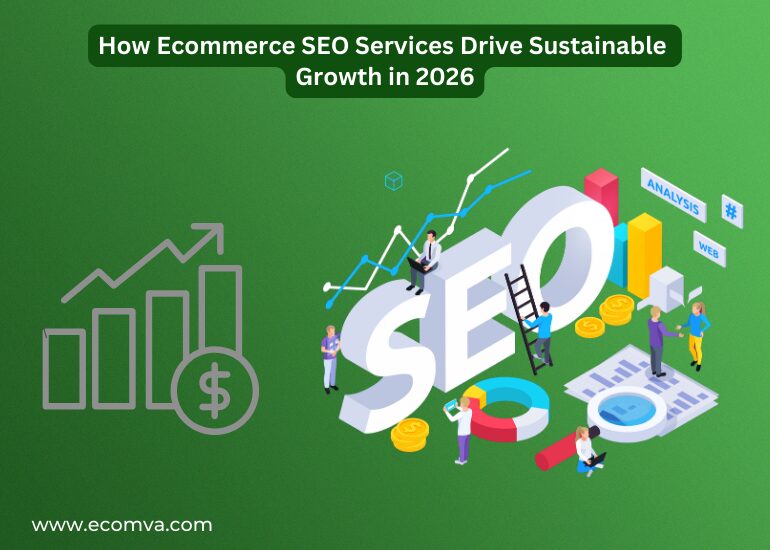
How Ecommerce SEO Services Drive Sustainable Growth in 2026
“The best place to hide a dead body is page two of Google search results.” — Rand Fishkin, Co-founder of Moz
This widely cited remark highlights a simple reality of digital commerce: visibility determines revenue potential. When product pages and category listings appear consistently in top search positions, ecommerce brands gain steady traffic, making ecommerce SEO services a foundational growth investment rather than an optional tactic.
Search-driven acquisition builds long-term stability because rankings, once established and maintained correctly through ecommerce SEO services, continue generating qualified visitors month after month. Brands relying on structured optimization reduce dependence on rising advertising costs.
Industry specialists across the ecommerce SEO space repeatedly stress that structured search optimization plays a central role in scalable growth. Technical indexing systems and organized category frameworks allow large product catalogs to remain discoverable even as inventory expands.
Businesses that invest early in ecommerce SEO services create compounding visibility advantages, allowing their online stores to capture consistent demand across both high-volume and long-tail search queries.
In 2026, sustainable ecommerce growth is closely tied to how effectively brands manage technical performance and search-driven content systems. Companies that implement organized ecommerce SEO services frameworks position themselves to maintain predictable customer acquisition and long-term organic revenue expansion.
Why do ecommerce businesses need SEO services for sustainable growth in 2026?
Digital commerce competition continues to rise across every industry. Paid advertising costs fluctuate, while organic search remains a stable acquisition channel that delivers consistent long-term value. Many brands now rely on ecommerce SEO services to build predictable customer acquisition pipelines that support monthly revenue planning.
Search behavior has shifted toward transactional and comparison-based queries. Shoppers review product specifications, pricing, and shipping terms directly from search results. When product pages rank consistently, stores receive recurring traffic without continuous ad spend increases. Businesses that implement ecommerce SEO services early create a long-term advantage through accumulated rankings, indexed product pages, and structured internal linking.
Organic search also supports acquisition consistency. Once category and product rankings stabilize, traffic patterns become more predictable. This stability allows brands to forecast inventory planning, promotional cycles, and marketplace expansion with higher confidence.
What do modern ecommerce SEO services include in 2026?
Modern SEO execution for ecommerce platforms combines technical performance, product-level optimization, and structured content systems. A specialized ecommerce SEO service provider evaluates the entire site structure, including crawlability, indexing rules, and catalog hierarchy, ensuring that search engines can access and understand thousands of product pages efficiently.
Key components included in modern SEO execution:
| SEO Component | Operational Focus | Business Impact |
|---|---|---|
| Technical SEO | Crawl budget control, indexing rules, and Core Web Vitals | Stable search visibility |
| Product SEO | Product titles, structured data, product content frameworks | Higher transactional rankings |
| Category SEO | Keyword mapping, internal linking, category content modules | Category authority growth |
| Content SEO | Buying guides, comparison pages, and FAQ indexing | Long-tail search coverage |
Structured implementation ensures scalability. Stores managing large inventories rely on ecommerce SEO services to maintain ranking consistency as new products are added. Enterprise teams also integrate ecommerce store management workflows with SEO processes so product uploads, category updates, and URL structures remain aligned with ranking objectives.
What strategies do ecommerce SEO services use to drive sustainable growth?
Structured strategies define how ecommerce SEO services generate long-term growth. Execution typically begins with search intent mapping, which connects keyword clusters to category, product, and informational pages. This mapping prevents internal competition between pages targeting the same queries.
Core strategies applied in 2026 include:
1. Catalog architecture optimization
Clear category hierarchies reduce crawl confusion and help search engines understand product relationships.
2. Product page indexing control
Variant URLs, filters, and parameters are configured to avoid duplicate indexing while preserving product discoverability.
3. Internal linking frameworks
Category-to-product and product-to-related-product linking increases crawl depth and strengthens ranking signals across the catalog.
4. Conversion-focused content modules
Buying guides, specification comparisons, and FAQs placed within category pages increase transactional relevance.
An experienced ecommerce SEO agency applies structured testing cycles to evaluate ranking movement, index coverage, and revenue attribution. These controlled implementation cycles form the operational backbone of professional ecommerce SEO services, ensuring that technical and content changes align with measurable results.
Which tools do ecommerce SEO services use in 2026?
Execution at scale requires a combination of technical monitoring, keyword intelligence, and performance attribution tools. Teams delivering ecommerce SEO services rely on automated tracking systems that monitor index coverage, ranking volatility, and organic revenue contribution.
Common tool categories include:
| Tool Category | Purpose | Example Use Case |
|---|---|---|
| Crawl Monitoring Tools | Detect indexing errors and crawl issues | Identify blocked product pages |
| Keyword Intelligence Tools | Track ranking movement across categories | Monitor category keyword stability |
| Log File Analysis Tools | Analyze crawler behavior | Detect crawl budget inefficiencies |
| Analytics Platforms | Attribute revenue to organic search | Measure organic conversion performance |
A reliable ecommerce SEO service provider integrates these tools into reporting dashboards that show category-level and product-level performance. Consistent monitoring enables faster response to ranking fluctuations and indexing changes.
What results can you expect from EcomVA’s ecommerce SEO services?
EcomVA delivers enterprise-level SEO execution designed for scaling ecommerce operations. Their professional ecommerce SEO services combine platform expertise, technical optimization, and structured content systems that align with revenue-focused KPIs.
EcomVA supports multiple ecommerce platforms, including Shopify, WooCommerce, Magento, and BigCommerce, ensuring platform-specific optimization workflows. Their team operates as a full-service ecommerce SEO agency, working alongside development, merchandising, and marketing teams to maintain consistent implementation cycles.
Enterprise capabilities provided by EcomVA
- Platform-specific SEO execution for large product catalogs
- Category and product keyword mapping frameworks
- Structured data deployment across thousands of pages
- Indexing and crawl efficiency monitoring
- Category content development for transactional search visibility
EcomVA also supports businesses seeking a long-term ecommerce SEO service provider that integrates SEO planning with digital operations. Their operational systems align with enterprise workflows such as catalog uploads, pricing updates, and seasonal category expansions, ensuring SEO performance remains stable during growth phases.
In addition to SEO, EcomVA provides virtual assistant teams handling product uploads, catalog structuring, and platform operations, enabling synchronized SEO execution and operational scaling. This combination of SEO and operational support ensures that ecommerce SEO services translate directly into measurable revenue outcomes.
Example KPI impact areas
| KPI Area | SEO Contribution |
|---|---|
| Organic Traffic Growth | Category and product rankings expand search visibility |
| Conversion Rate Stability | Transactional search intent alignment improves purchase intent traffic |
| Revenue Attribution | Organic search becomes a predictable acquisition channel |
| Catalog Index Coverage | More indexed products increase discovery potential |
Businesses working with EcomVA typically engage ongoing ecommerce SEO services programs designed for long-term scalability rather than short-term ranking spikes. Continuous audits, implementation cycles, and reporting systems ensure operational consistency.
How can structured ecommerce SEO services create long-term growth stability?
Sustainable ecommerce growth requires structured visibility systems rather than temporary acquisition tactics. Stores that invest early in ecommerce SEO services establish ranking authority across categories, maintain predictable acquisition patterns, and reduce dependence on fluctuating advertising costs.
Long-term collaboration with a specialized ecommerce SEO agency creates operational alignment between technical SEO, catalog management, and content systems, enabling steady expansion of organic revenue channels.
FAQs
1. What are ecommerce SEO services?
They include technical optimization, product page optimization, category SEO, and content systems designed to increase organic traffic and transactional rankings.
2. How long does ecommerce SEO take to show results?
Initial indexing and ranking adjustments typically appear within three to six months, while category authority growth continues over longer optimization cycles.
3. What KPIs should ecommerce businesses track for SEO success?
Key indicators include indexed product count, category ranking distribution, organic revenue contribution, and transactional keyword visibility.
4. Should ecommerce brands hire an ecommerce SEO agency or build an in-house team?
Many brands partner with a specialized ecommerce SEO agency when managing large catalogs or multi-platform operations that require dedicated technical and content expertise.