Enterprise ecommerce SEO vs SMB SEO: Why Large-Scale Stores Need a Completely Different Strategy

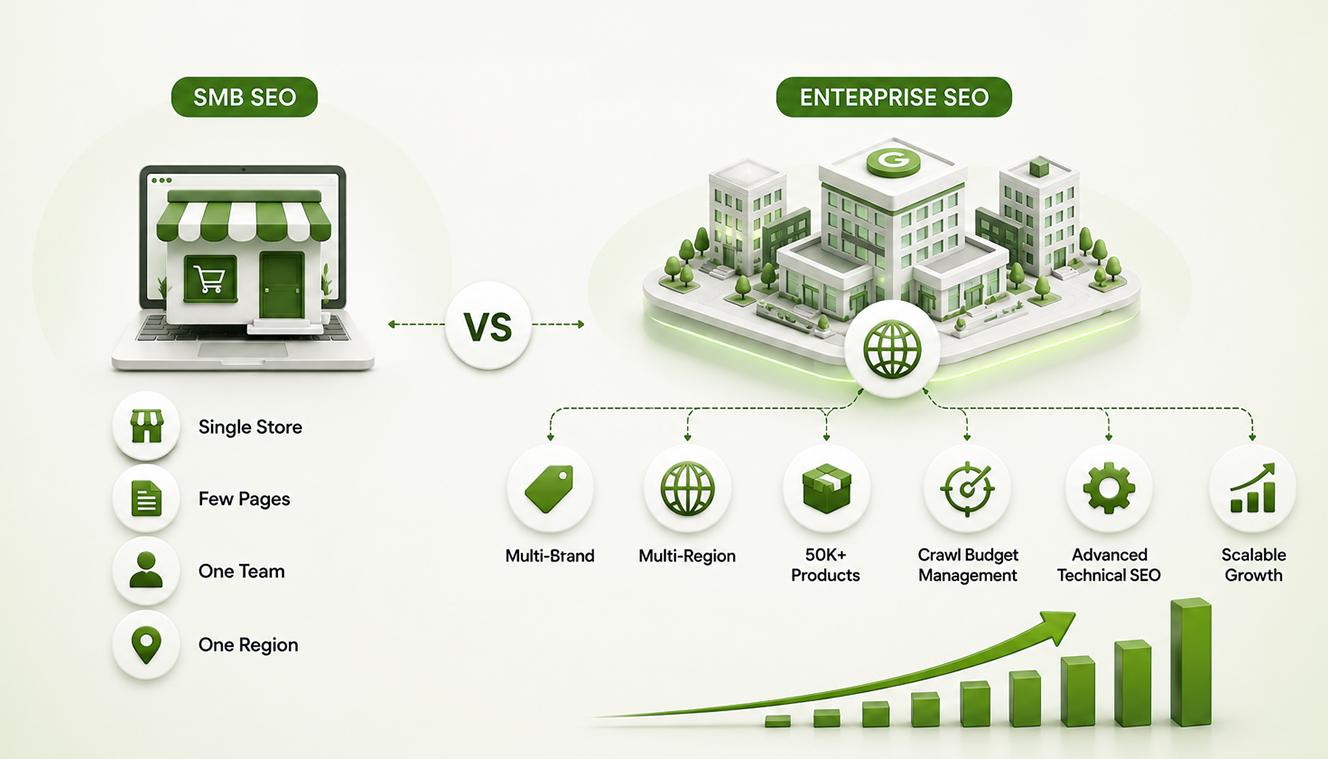
Enterprise stores aren’t just bigger versions of small ones. They run on different infrastructure, different teams, different risks, and a different idea of what “winning” even means. Treating an enterprise ecommerce SEO like a scaled-up version of SMB tactics is one of the fastest ways to burn through a six-figure SEO budget.
If you’ve ever taken SEO advice meant for a small Shopify store and tried using it on a catalog with 50,000 SKUs, you already know the problem. It just doesn’t scale.
Most SEO advice out there is written for the same kind of reader- a solo founder or small team running one store, one brand, one country. Fix a title tag, write a blog post, clean up some broken links, and watch traffic slowly climb. That works fine with 200 pages.
It falls apart once you’re running an enterprise operation.
The Real Difference: Enterprise SEO vs Small Business SEO
People assume enterprise SEO vs small business SEO is just a matter of degree. More pages, more keywords, more content, same playbook. That’s not quite right.
A small store might have one product line, one warehouse, and one currency. An enterprise store could be running:
- Multiple brands under one parent company
- Several regional or international storefronts
- Dozens of category and subcategory templates
- Hundreds of stakeholders who can each break something with one careless edit
That last point matters more than people expect. A small business owner can push a site change themselves in an afternoon. At the enterprise level, a single sitemap fix might require sign-off from legal, IT, three regional marketing leads, and possibly a dev team.
Technical SEO Gets Genuinely Harder at Scale
This is where things really diverge. Enterprise technical SEO isn’t about fixing a few broken links. It’s about managing systems.
| Factor | SMB Store | Enterprise Store |
|---|---|---|
| Crawl budget | Rarely a limiting factor for smaller websites | Can become a significant constraint with 100,000+ URLs |
| Duplicate content | Usually limited to a small number of similar pages | Faceted navigation and URL parameters can generate millions of near-duplicate URLs |
| Site speed | Often involves optimizing a single storefront or template | Requires performance optimization across multiple templates, brands, and regional sites |
| Indexing control | Typically managed with straightforward robots.txt and sitemap settings | Often requires complex handling of subdomains, ccTLDs, parameter URLs, and indexing directives |
| Change deployment | Updates can usually be implemented within hours or days | Changes often move through development, QA, compliance, and release cycles before deployment |
Crawl budget is a good example. Google can’t crawl every URL on a massive site every day, and it won’t try. If your filters – size, color, price, sort order – keep generating thousands of low-value URL combinations, you’re wasting crawl budget on pages nobody needs indexed. In contrast, your real money pages sit waiting for their turn.
A small store will basically never hit this limit. A large one hits it constantly.
This is why SEO for large ecommerce stores has to start with architecture, not content. You can write the best product description in the world, but if Googlebot can’t find and prioritize that page, it won’t matter much.
Content Strategy Isn’t Just “Write More Blog Posts”
Here’s where a lot of enterprise teams misunderstand. They treat content like SMB content, just at a higher volume. More blogs. More category pages. More everything.
But an effective enterprise SEO content strategy isn’t about volume. It’s about topical authority across an entire ecosystem of brands, categories, and regions, without those pieces competing against each other for the same rankings.
Consider a multi-brand retailer selling outdoor gear under three different brand names. If each brand’s content team is working in isolation, you’ll get three separate blog posts all targeting “best hiking boots for beginners,” all fighting each other in the same search results. That’s not redundancy, that’s self-sabotage.
A real multi-brand SEO strategy requires a shared content map across the whole organization. One place where someone can see, at a glance, who owns which keyword cluster, so brands complement instead of cannibalize.
Small businesses don’t deal with this. They’ve got one brand, one voice, one content calendar. Enterprise teams need governance just to avoid stepping on their own feet.
EEAT and the 2026 Core Update Changed the Math
Google’s continued emphasis on Experience, Expertise, Authoritativeness, and Trust hits enterprise sites differently than small ones, mostly because enterprise sites have more to prove and more surface area where trust can break down.
A small store can build trust through a founder’s story, a few genuine reviews, and an “about us” page that actually sounds human. That goes a long way at a small scale.
An enterprise store gets judged page by page, brand by brand. One weak, AI-written category description on brand B can quietly hurt the trust that brand A spent years building. Google looks at patterns across the whole domain, not just single pages.
Practically, that means:
- Author bios and real expertise need to be visible
- Product pages need original specs and details
- Reviews need to be genuine and structured with proper schema
None of this is exotic advice. It’s just much harder to execute consistently when you’re managing it across dozens of templates and teams instead of one small site.
Where Enterprise Teams Actually Lose the Most Time
The biggest delay in large teams isn’t strategy, it’s coordination. What takes a small team minutes can take weeks in an enterprise setup because many people are involved.
That’s normal at this scale. But it also means your enterprise SEO strategy must account for slower execution. You can’t do everything at once, so focus on fixing the highest-impact issues first instead of trying to act on every audit recommendation.
So, What Should You Actually Do Differently?
A few things tend to matter most at this scale:
- Start with crawl budget and indexation, not content.
- Build one keyword map across all brands so teams aren’t quietly competing with each other.
- Make ownership clear. Know who can actually push a technical fix, and how fast it’ll happen.
- Treat EEAT as a standard for the whole site, not something you handle case by case.
- And track rankings by template or section, not just site-wide. Problems hide in averages.
None of this is exciting. It’s mostly just discipline, kept up across a much bigger site than a small store ever has to manage.
If your old tactics aren’t working anymore, it’s time for a proper SEO audit. It should be done by experts and built for your current scale, not the one you had before.
Frequently Asked Questions
1. Is enterprise SEO just SMB SEO done on a bigger scale?
No. While both follow the same SEO fundamentals, enterprise SEO involves far greater technical complexity, governance, and coordination across large catalogs, multiple brands, or regional websites.
2. What’s the single biggest technical issue enterprise ecommerce sites face?
One of the most common challenges is crawl budget being consumed by duplicate or low-value pages created through faceted navigation and URL variations, which can reduce overall search performance.
3. How long does it usually take to see results from an enterprise ecommerce SEO strategy?
Enterprise SEO initiatives typically require six to twelve months before significant results become visible, as implementation, testing, and indexing occur over longer timelines.
4. Does every brand under one company need its own SEO strategy?
Yes. Each brand should target its own audience, messaging, and keywords while following a unified SEO framework that prevents internal competition and maintains consistency across the organization.